
Dedication
We are available 24/7
Field sobriety tests look simple. They are built on far more specific criteria than most people realize, and both taking and refusing them carry consequences.
Get a Free Case ReviewWe are available 24/7
Nearly 30 years of combined criminal defense experience
A former Oregon prosecutor now fights on your side
More than 60 trials fought in the courtroom
| Test | What It Measures | Reliability |
|---|---|---|
| Horizontal Gaze Nystagmus (HGN) | Involuntary eye jerking across three phases | Some studies link all six clues to a BAC above 0.08 |
| Walk and Turn | Balance and instruction-following across 8 indicators | 2 or more indicators linked to a BAC around 0.10, about 68 percent of the time |
| One Leg Stand | Balance across 4 indicators | 2 or more indicators linked to a BAC around 0.10, about 65 percent of the time |
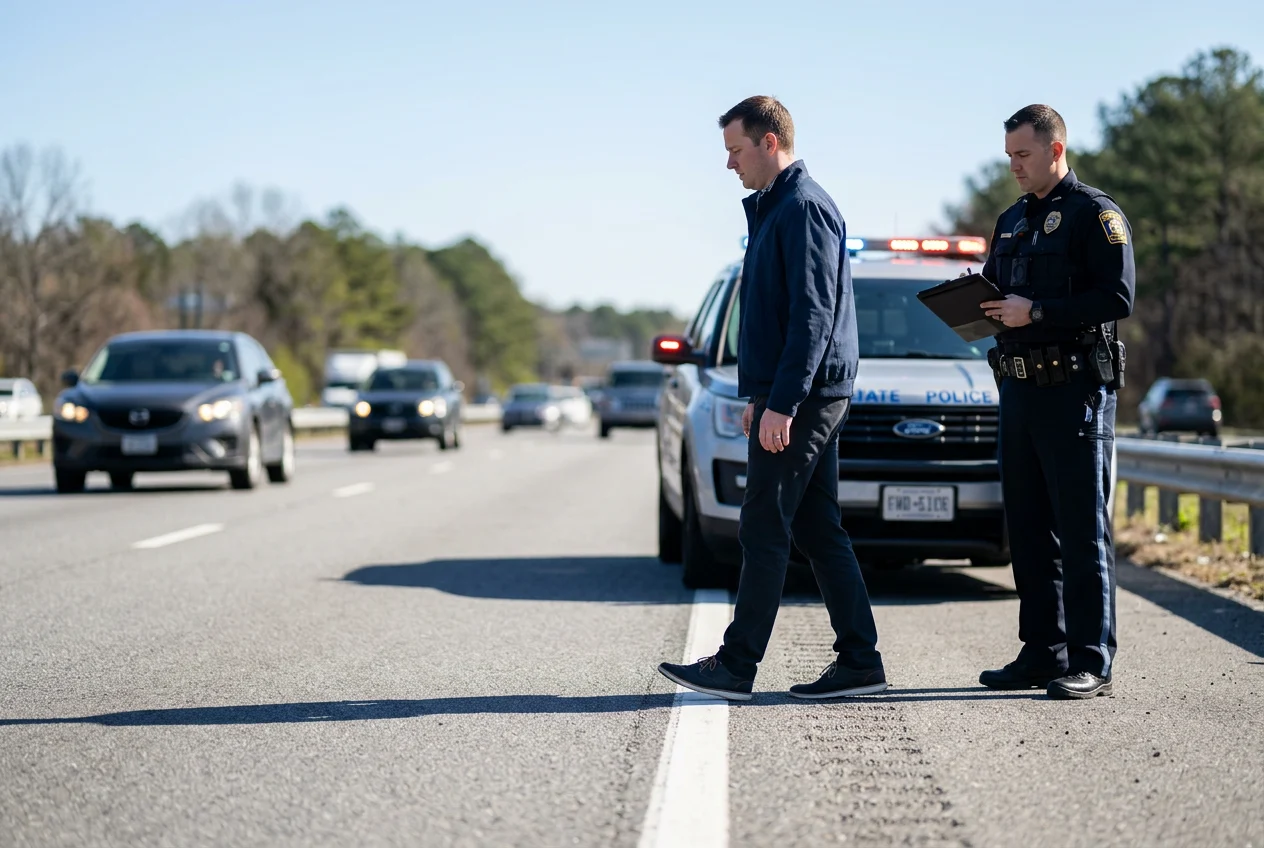
DUI Field sobriety tests are a battery of mental and physical tests police put drivers through to decide whether a driver has been drinking and whether the driver seems impaired by alcohol. Field sobriety tests are voluntary under the law. In fact, the tests are inadmissible in court if the police don't tell you that they are voluntary. However, Washington DUI law defines voluntary to mean simply that it is not against the law to refuse the tests. Prosecutors are allowed to argue to a jury that a refusal to do the tests is evidence of guilt. Another problem with field sobriety tests is that they are built on shaky science. Field sobriety tests are often poorly documented. Therefore at trial, the officer simply testifies as to how the person did on the tests. So, to take or not to take DUI Field Sobriety Tests? That is the question. There are consequences to both taking and refusing field sobriety tests. Unless you are very familiar with the tests, it is possible to fail simply because you didn't know what was being tested. Refusing to take the tests can also be used against you. Proceed with caution, whichever way you choose. Either way, understanding how the tests work will better help you decide what choice to make.
The Horizontal Gaze Nystagmus (HGN) test is an eye test. It is the DUI field sobriety test where the officer has you follow his pen with your eyes. At its most basic level, the HGN test checks for nystagmus (involuntary jerking of the eye muscles). While everyone experiences nystagmus, it is often imperceptible. Drinking alcohol causes nystagmus to worsen so that it can be observed.
Your eyes are moved by your eye muscles. When you look anywhere other than straight ahead, your eye muscles have to do work. As your eye muscles work, they get tired. Nystagmus is when the strain is noticeable. Imagine if you held a dumbbell up with your arm. Eventually, your arm would get tired and your arm would shake from fatigue. Your eyes are no different. If you strain your eyes to the side, your eyes will jerk back towards center imperceptibly. As you drink alcohol, the nystagmus becomes more pronounced and can be seen. The HGN test checks for nystagmus in three phases, where a total of six clues of nystagmus are tested (three phases times two eyes per phase).
In the first phase, officers check for a "lack of smooth pursuit". In this phase, the officer passes the pen slowly from side to side, back and forth. The officer looks to see if the eye jerks (stops and starts) along the path of following the pen. If both eyes jerk, that constitutes two clues of nystagmus.
In the second phase, officers check for "distinct and sustained nystagmus at maximum deviation". In this phase, the officer holds the pen off to one side of your peripheral vision and asks you to focus on the pen. The officer is checking for "distinct and sustained" nystagmus. The phase is repeated for the second eye and if both eyes jerk, that constitutes two more clues of nystagmus.
In the third phase, officers check for an "onset of nystagmus prior to 45 degrees". In this last phase, the officer holds the pen about 45 degrees off from just in front of your nose (i.e., just past your ear). After testing both eyes, if the officer sees jerking at this lesser angle in both eyes, that constitutes two final clues of nystagmus. Officers are trained to say you failed this test if they see four "clues" of nystagmus out of the six possible. The science behind this test suggests that the first type of nystagmus you will show from drinking is the "lack of smooth pursuit". As you get more impaired, you will show "distinct and sustained nystagmus at maximum deviation". The more alcohol you consume, you will eventually show an "onset of nystagmus prior to 45 degrees". There have been some correlation studies holding that showing all six clues is a reliable indicator that your blood alcohol concentration is above the legal limit of 0.08%.
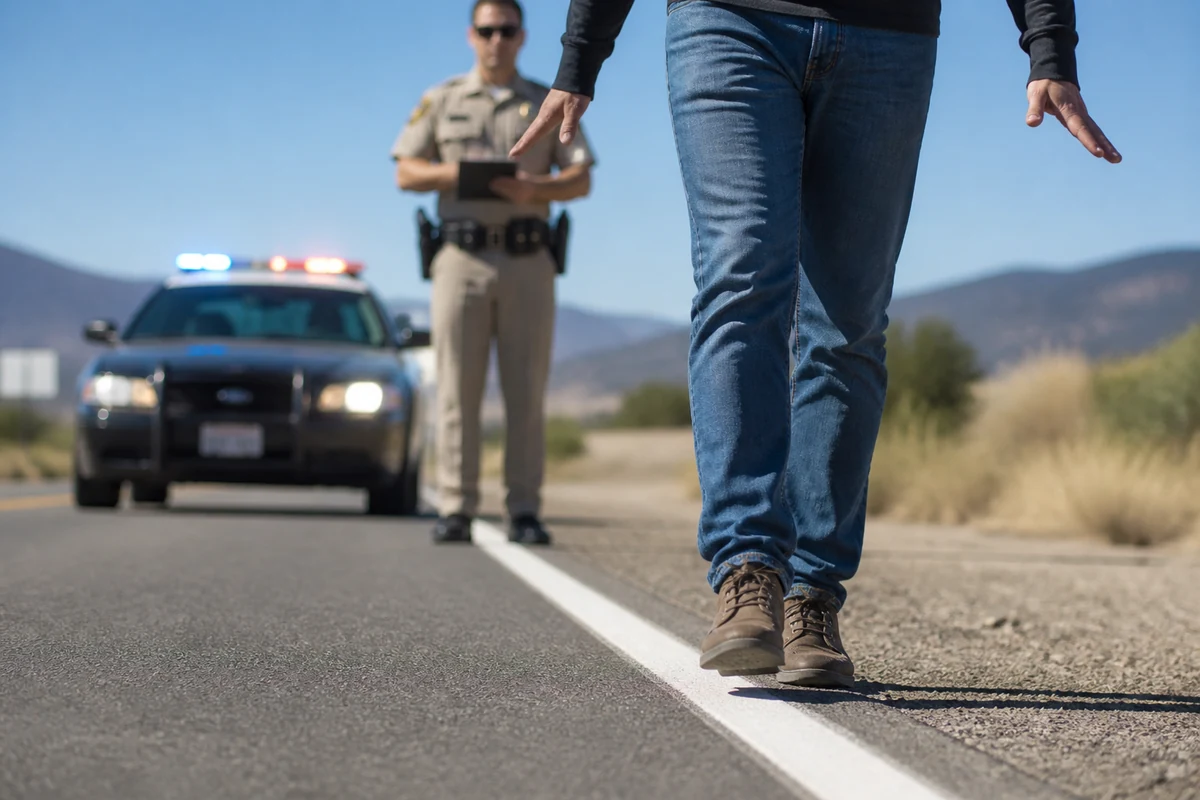
The second test during a routine DUI arrest investigation is a "divided attention test" called the "Walk and Turn Test". A divided attention test is designed to divide one's attention amongst several tasks, including listening to instructions, remembering the instructions, following the instructions, performing physical tasks, and performing mental tasks all at the same time. During the Walk and Turn test, the officer tells you to stand with one foot in front of the other, touching heel-to-toe, while receiving the instructions. The purpose of having you stand this way is to force you to receive the instructions while balancing, thereby dividing your attention between the two tasks. While standing there, you are instructed that you will take nine steps down a line (often imaginary), touching each step heel-to-toe, and counting each step out loud while looking at your feet. After nine steps, you are instructed that you will keep your lead foot planted and take a series of small steps with your other foot until you are facing down the line. You are then instructed to take nine more steps back down the line in the exact manner as before. Once the instructions are finished and you are given an opportunity to ask any clarifying questions, the officer looks for 8 specific indicators of impairment: whether you can balance during the instructions, whether you start the test before the instructions are done, whether you stop while walking, whether you fail to touch heel-to-toe on any steps, whether you step off the line, whether you use your arms for balance, whether you lose your balance during the turn or turn incorrectly, and whether you take the wrong number of steps. The National Highway Traffic Safety Administration validation studies indicate that showing 2 or more of the above indicators of impairment are 68% reliable to show a blood alcohol concentration of 0.10%. If you step off line 3 or more times, seem to be in danger of falling, or cannot complete the test at all, officers are taught to end the test and consider that a "failure" of the test.
The final standardized field sobriety test is another divided attention test, called the One Leg Stand Test. In that test, the officer instructs you to stand with your feet together while you receive the instructions. You are instructed to raise one leg of your choosing and maintain the other foot about 6 inches off of the ground and parallel to the ground. While looking at that foot, you are supposed to count out loud "one thousand and one", "one thousand and two", "one thousand and three", etc. The officer keeps time and tells you to stop when his timer reaches thirty. During the test, the officer looks for 4 specific indicators of impairment: whether you sway while balancing, whether you use your arms for balancing, whether you hop, and whether you put your foot down. Officers are trained that 2 or more of these indicators constitutes a failure of the test. The NHTSA validation studies suggest that 2 or more of these indicators shows a blood alcohol concentration of 0.10% approximately 65% of the time. If you put your foot down 3 or more times during the test or cannot complete the test, the officer is trained to end the test and treat it as a failure.
Officers often want to make sure you are DUI before making an arrest, so they offer a portable breath test. Any competent DUI attorney in Washington can keep portable breath test results out of your trial, because they are unreliable. Because they are inadmissible at trial, your decision to take or refuse the portable breath test matters little at trial. However, the results of a portable breath test can be used in pretrial hearings to attack or support probable cause when trying to suppress evidence. Therefore, there may be reasons for and against taking a portable breath test. Some individuals who think they might be below the legal limit may wish to take a practice go before deciding whether to provide a later breath test at the police station or jail.
Contact us
Free consultation. Available 24/7. We quote a flat fee up front and offer payment plans on most cases. The number we quote is the number you pay, no matter how many hearings your case takes.

Cases we handle
Mandatory jail, fines, and license suspension apply even to a first arrest. We fight for a reduction whenever the facts support one.
Learn more
Your license can be suspended before your criminal case is even resolved. You have only 20 days to fight it.
Learn more
Most DUI charges carry up to 364 days in jail. We build a defense around every stage of the case, not just the arrest.
Learn more
Multiple prior convictions can turn a DUI into a felony. We look hard at whether every prior conviction actually holds up.
Learn more
A path to a full dismissal for qualifying cases, in exchange for a serious, multi-year treatment commitment.
Learn more
Refusing carries its own penalties, but it can also weaken the state's case at trial. We help clients weigh both sides.
Learn more
Mandatory jail, fines, and license suspension apply even to a first arrest. We fight for a reduction whenever the facts support one.
Learn more
Your license can be suspended before your criminal case is even resolved. You have only 20 days to fight it.
Learn more
Most DUI charges carry up to 364 days in jail. We build a defense around every stage of the case, not just the arrest.
Learn more
Multiple prior convictions can turn a DUI into a felony. We look hard at whether every prior conviction actually holds up.
Learn more
A path to a full dismissal for qualifying cases, in exchange for a serious, multi-year treatment commitment.
Learn more
Refusing carries its own penalties, but it can also weaken the state's case at trial. We help clients weigh both sides.
Learn more4.9 star reviews based on 110+ reviews
FAQ
No, they are voluntary, though refusing can be used against you at trial.
Yes. These tests grade small details like balance, arm movement, and following precise instructions, so nervousness, fatigue, injuries, footwear, or uneven ground can all produce clues that look like impairment. That is one reason the results are often challengeable at trial.
No. Even under ideal conditions the standardized tests are only correlated with impairment a percentage of the time, and accuracy drops when officers give incorrect or incomplete instructions or fail to record the test. An attorney can examine how the test was administered and documented to challenge the results.
Contact us
Free consultation. Available 24/7. We quote a flat fee up front and offer payment plans on most cases. The number we quote is the number you pay, no matter how many hearings your case takes.